|
Software stocks just got their teeth kicked in.
The iShares Expanded Tech-Software Sector ETF (IGV) is down 24.3% year-to-date, posting its worst quarterly drop since 2008. The trigger? Fears that agentic AI will gut the SaaS business model from the inside out.
Names like Adobe, Salesforce, and Oracle have been hit hard. Microsoft sits in a 26% drawdown.
Our TrackStar data shows IGV pulled in 6,997 financial pro searches last month, nearly 4x its closest competitor XSW. That kind of attention rarely shows up without a fight brewing underneath.
Here's the question worth asking: is this a generational buying opportunity, or the start of something worse?
Key Facts About IGV
- Net assets: $11.7 billion
- 12-month trailing yield: 0.04%
- Inception: July 10, 2001
- Expense ratio: 0.39%
- Number of holdings: 111
IGV tracks the S&P North American Expanded Technology Software Index. The fund holds 111 software, interactive media, and home entertainment names across the U.S. and Canada.
This isn't pure SaaS. The "expanded" piece pulls in interactive media and gaming companies, giving the fund slightly more diversification than its name suggests.
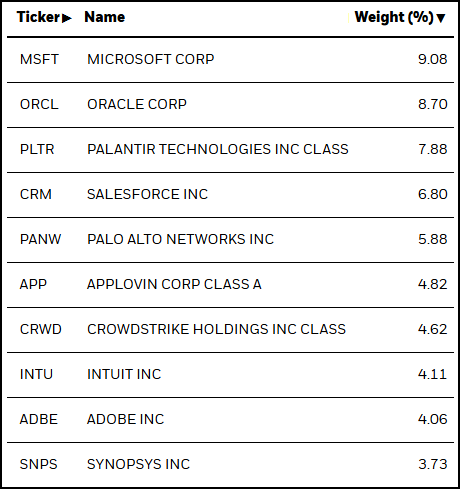
But make no mistake, IGV is concentrated. The top 10 holdings account for roughly 60% of the portfolio.
Source: iShares
These are the names that have to defend their moats as AI agents reshape enterprise workflows. If they hold the line, IGV bounces. If they don't, the re-rating isn't done.
Adobe, AppLovin, CrowdStrike, Intuit, and Synopsys round out the top ten, each with a different angle on the software story.
Performance
The numbers are ugly in the short term and respectable everywhere else.
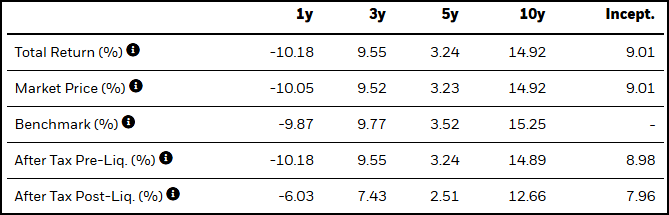
IGV is down 24.3% YTD and down 10.2% over one year. That trails the broader tech category, which is up roughly 31% over the past year. The five-year return sits at just 3.2% annualized, dragged down by 2022 and the recent selloff.
But zoom out and the picture changes. The 10-year annualized return is 14.9%, and since inception in 2001 the fund has compounded at roughly 9.0% annually.
Source: iShares
The fund trades at a 18.7x P/E ratio, well below its March 31 fact sheet level of 31.7x. That's the math of a fast selloff. Whether that multiple compression reflects justified fear or overshooting sentiment is the trillion-dollar question.
Competition
IGV isn't the only way to play software, and our TrackStar data surfaced the alternatives that financial pros are weighing.
- SPDR S&P Software & Services ETF (XSW): XSW uses an equal-weight approach across 137 holdings with a 0.35% expense ratio. The equal weighting tilts the fund toward smaller software names rather than the megacap concentration in IGV. Year-to-date losses have been milder thanks to that diversification, but long-run returns have lagged IGV when megacaps lead.
- Invesco AI and Next Gen Software ETF (IGPT): IGPT focuses specifically on AI and next-gen software companies, charging 0.56% with 101 holdings. The fund posted an 86.9% one-year return, the standout performer in the group, reflecting concentrated bets on AI beneficiaries like Nvidia and Meta rather than traditional SaaS.
- AOT 2x Daily Software Platform ETF (SOFL): SOFL is a 2x leveraged play on software platforms with a 1.29% expense ratio. It launched in July 2025 and remains tiny at $0.005 billion in assets. Built for traders, not investors, the daily reset makes it dangerous to hold through volatility.
- Amplify Cybersecurity ETF (HACK): HACK targets cybersecurity specifically with 24 holdings and a 0.60% expense ratio. The fund is down 23.2% over the past year as cybersecurity got caught in the AI software panic, despite arguably being one of the few areas where AI agents create more demand, not less.
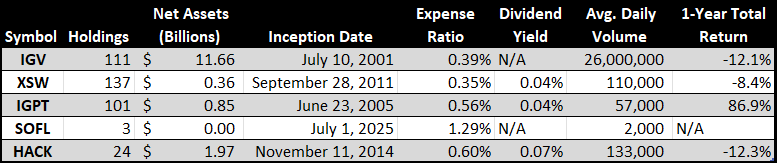
IGV stands out for liquidity and direct exposure to the largest software franchises. But the concentration cuts both ways in moments like this.
Our Opinion 6/10
IGV is the cleanest way to bet that software franchises survive the AI transition, and it's now trading at a meaningfully cheaper multiple than it was six months ago.
The bull case is real. Goldman has flagged tech as undervalued relative to expected growth. Companies like Salesforce and Intuit have already shipped AI-integrated products that enhance rather than replace their offerings.
The bear case is also real. Top-10 concentration of 60% means IGV's fate rides on a handful of names defending their moats. If AI agents commoditize SaaS faster than expected, this fund has further to fall.
Best for investors with a 3 to 5 year horizon who believe enterprise software adapts rather than dies. Position size should reflect the volatility, this isn't a core holding for the faint of heart in 2026.
|